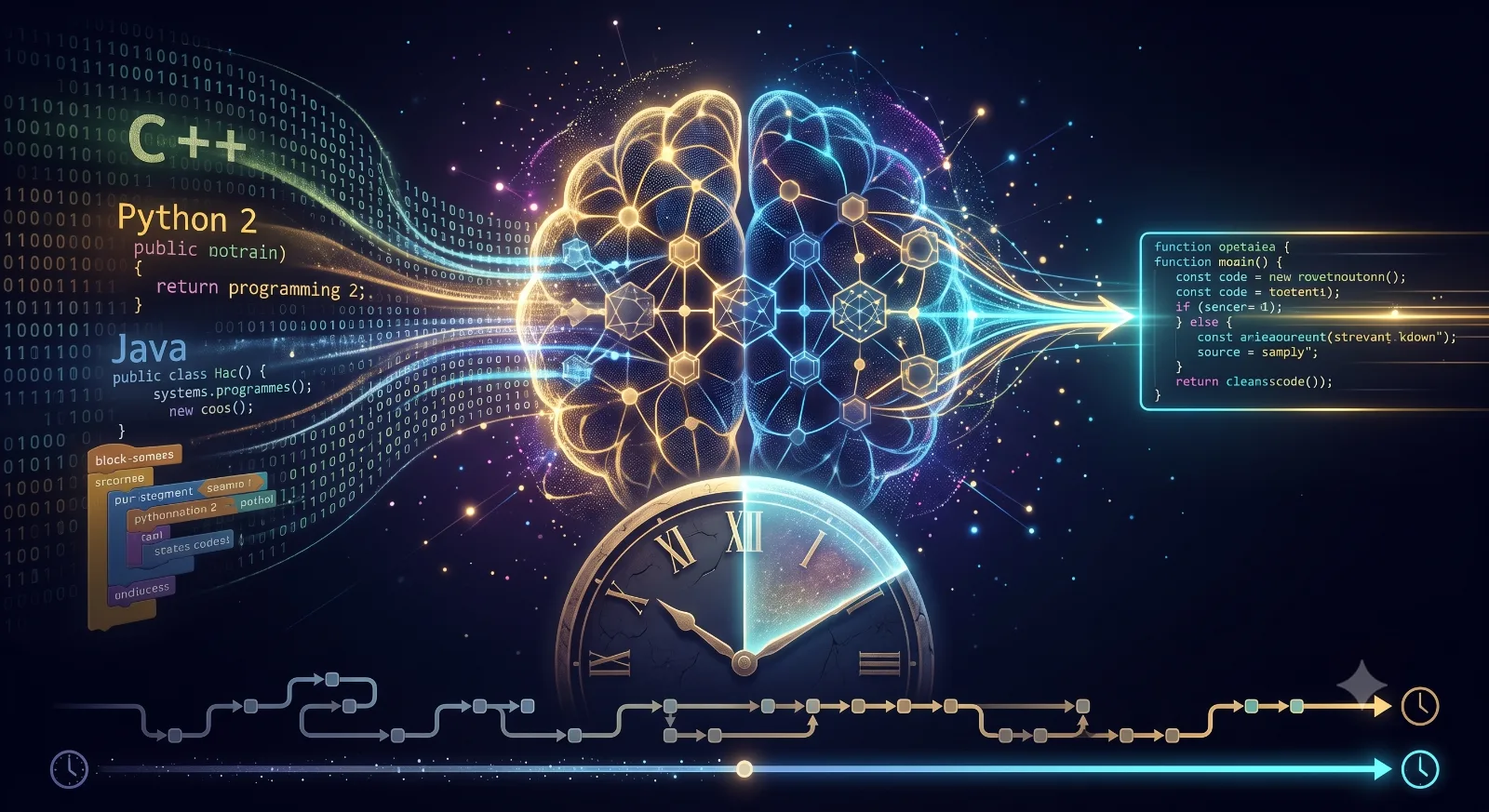
The problem isn't that the system is old — it's that it can no longer change
A system doesn't become legacy because of its age. Many organizations run Core Systems built 15 or 20 years ago — probably in Visual Basic, COBOL, or obsolete Java versions — that, while stable, have become immutable black boxes. The system works, but every change takes weeks, every deployment needs a maintenance window, and every new integration is a project in itself.
The real cost of legacy isn't in keeping it running — it's in everything it prevents the business from doing: responding faster to the market, adopting new technologies, scaling without multiplying infrastructure, and retaining a technical team that doesn't want to work on unsupported frameworks.
Java 8→21: the migration that can no longer wait
Java 8 reached end of public support years ago. Versions 11 and 17 are in extended support, but Java 21 (LTS, September 2023) is the current standard for production systems. The gap between Java 8 and 21 isn't a version bump — it's a decade of accumulated changes: virtual threads (Project Loom), pattern matching, records, sealed classes, and a completely different module model.
What does migrating involve? Dependencies that no longer compile, removed internal JVM APIs (javax → jakarta), frameworks requiring minimum versions (Spring Boot 3+ needs Java 17+), and behaviors that silently changed between versions. It's not "changing the version number in the POM." It's surgery on a production system.
AI accelerates this phase: model-assisted static analysis tools map real dependencies, identify incompatible code and generate the migration scaffold — but the decision of what to migrate, in what order, and what to leave alone remains human.
.NET Framework → .NET Core / .NET 8+: same urgency, different ecosystem
.NET 6 lost support in 2024; .NET 8 reaches end of life in November 2026, and .NET 10 LTS is already in preview. Applications on classic .NET Framework (Web Forms, WCF) have no automatic migration path — they require redesigning the presentation layer and service contracts.
The range goes from six weeks for a clean MVC migration to 18 months for a 1-million-line monolith with WCF and Web Forms. In the .NET ecosystem, Roslyn-based semantic analysis and LLMs automate code refactoring and boilerplate generation, and Microsoft's AI abstractions integrated via Microsoft.Extensions.AI speed up test-scaffolding generation.
Monolith → Microservices: not everything deserves to leave
The most common trap is assuming modernizing = splitting everything into microservices. A microservice carries a fixed cost that never disappears: its own deployment, its own database, its observability, its network contract, the team keeping it alive at 3 a.m. That cost is only justified when a capability has a real reason to live separately: it changes at a different pace, it scales differently, or a different team owns it.
The stable, heavily coupled core of the monolith — the part that barely changes — almost always should stay put. Modernizing isn't about splitting everything up, it's about deciding what deserves to leave.
The proven pattern is Strangler Fig: an API Gateway sits in front of the monolith and each business capability is extracted one at a time as a microservice, gradually redirecting traffic without shutting down the original system. Traditional refactoring demands maintenance windows that stop production; under Strangler Fig, the migration is transparent.
Cloud migration: it's not a change of mailing address
Moving the virtual machine to the cloud isn't being cloud native. Cloud native is a way of building and operating applications that leverages the cloud model: decoupled services, containers, automation and resilience by design.
The real strategies aren't mutually exclusive — they combine depending on the system:
Rehost (lift & shift): move without changing code. Gains cloud infrastructure without touching the application. Useful as a first step off owned hardware, but doesn't solve architecture problems.
Replatform: containerize the current application (Docker/Kubernetes) without rewriting logic. Gains stability and automated deployment before touching a single line of business logic.
Refactor / Re-architect: extract modules as microservices, adopt per-service databases, asynchronous messaging. The biggest impact, the biggest effort.
From a CAPEX/OPEX perspective, the Big Bang model is unsustainable for many cash flows. Incremental modernization turns massive capital spend into controlled operating investment.
AI's role in modernization
AI accelerates every phase of modernization: code analysis, code generation and automated testing. Specifically:
Dependency mapping: analyzing millions of lines to identify real coupling (not the documented kind, the kind that actually exists in the code).
Scaffold generation: creating the microservice skeleton (OpenAPI contracts, Spring Boot/ASP.NET structure, initial tests) from the monolith's code.
Code migration: translating obsolete patterns to modern equivalents (e.g. callbacks to reactive streams, EJB to Spring Boot).
Test generation: covering code that never had tests with automated tests before touching it.
All with mandatory human review — AI accelerates, senior architects and developers decide.
The costliest mistake
A full rewrite forces you to chase feature parity with a system that keeps growing, and the cutover date slips every quarter. A Big Bang rewrite has a failure probability above 40%. It's the option that sounds cleanest on the whiteboard and has killed the most projects in practice.
The alternative that works is more boring but safer: extract, validate, deploy, repeat — with the old and new systems coexisting until the old one shuts down naturally, module by module.
The underlying question
It's not whether to modernize — the cost of not doing it grows every month in technical debt, unpatched vulnerabilities and degraded delivery speed. The question is whether to do it incrementally and controlled, or bet everything on a rewrite that historically fails more often than it works.
Sources: Spot IT Solutions, Shakers/McKinsey, Innowise, ESKOM.AI, Andes Digital, Tribulant/.NET Modernization 2026, CNCF — reviewed July 2026.
 Qi-Vanta
Automation and artificial intelligence for businesses. From discovery to production, with measurable ROI.