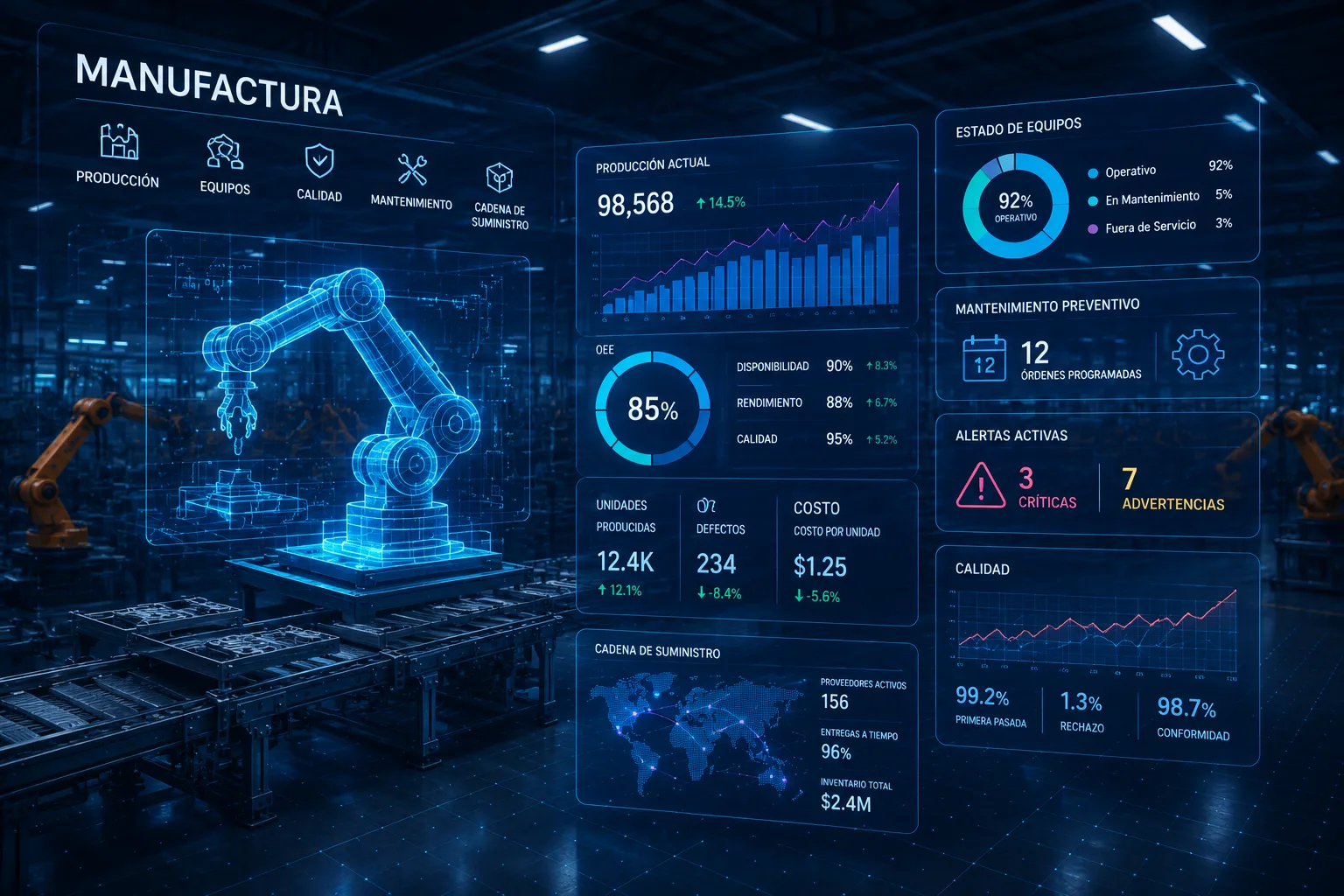
The historical moment that won't repeat
Banxico notes that 2026 formally marks the start of the nearshoring boom period, a strategic opportunity window extending through 2030. Mexico closed 2025 with record FDI of $40.87 billion and started 2026 with a new quarterly high: $23.6 billion in Q1, up 10.4% year-over-year. Manufacturing captured 41.2% of that FDI; computer and electronics equipment manufacturing pulled in $1.37 billion, up 58.7% annually.
Mexico captured $36 billion in nearshoring investment during 2025, and Nuevo León represented roughly 20% of that total, with an industrial occupancy rate of 97.2% and over 45 active industrial parks.
But the data point that matters most for any company's strategy working with manufacturing isn't the investment volume — it's the requirement that comes with it: companies setting up plants in Mexico under the nearshoring model demand Industry 4.0 standards: full traceability, automated quality control, and energy efficiency measured with data. It's not optional for anyone wanting to win those contracts.
The adoption gap is the opportunity
50% of national manufacturing companies plan to implement at least one Industry 4.0 technology in 2026; current adoption in Nuevo León is 42%. Translated: half the market is still in early digitization stage, in the country's most industrialized state.
92% of manufacturing executives surveyed by Deloitte expect smart manufacturing, backed by analytics and AI, to be the main competitiveness driver over the next three years. And 95% of manufacturers globally already use or evaluate smart-manufacturing technologies, according to Rockwell Automation. Intent far outpaces implementation — that's the opportunity.
Industrial AI in production: what works today
Quality control with machine vision. AI detects defects in milliseconds via industrial cameras and deep-learning models. In sectors like aerospace (Querétaro, Chihuahua), electronics (Baja California), and food and beverage, automated visual inspection runs 24/7 without fatigue, without shift-to-shift variability, with photographic evidence of every inspected piece. Quality standards become auditable and traceable per unit.
Predictive maintenance with IoT. IoT sensors on critical machinery with AI models predicting failures before they happen produce a 45% reduction in unplanned downtime and savings of up to $2 million pesos per plant per year in eliminated reactive maintenance. Bosch Mexico (Aguascalientes and Nuevo León) implemented digital twins with Siemens MindSphere and achieved a 30% downtime reduction on its automotive production lines during 2025.
Operational efficiency through automation. Foxconn in Chihuahua implemented AI-driven robot automation, resulting in 40% operational efficiency post-nearshoring. The pattern isn't exclusive to large corporations — the model is replicable in mid-size plants with pilots scoped to a specific line or process.
Digital twins. Virtual replicas of physical plants that let you simulate scenarios, reduce downtime, and optimize processes before implementing real changes. In a nearshoring context where the margin for error with a global client is minimal, simulating before executing stops being a luxury and becomes risk management.
The bottleneck isn't technology
68% of industrial employers report difficulty finding specialized profiles in critical areas like artificial intelligence, cybersecurity, data analytics, and robot programming — essential sectors for supplying high-value industries like aerospace and semiconductors.
The shortage of specialized technical talent is the real brake, not technology availability or investment. Companies solving this three ways gain ground: training their own operational staff on using AI tools (not developing them), working with external integrators for first pilots, and choosing solutions requiring low know-how to operate once implemented.
The map of where it's happening
Advanced manufacturing in Mexico has clear geography: Nuevo León (automotive, electronics), Querétaro and Chihuahua (aerospace), Baja California (consumer electronics), Guanajuato and Aguascalientes (automotive), Jalisco (electronics and technology). 0.2% of manufacturing companies generate 54.3% of the country's industrial value — geographic and corporate concentration makes the hubs the most efficient entry point for any technology provider.
Manufacturing represents nearly 22% of national GDP. Industrial digitization isn't optional — it's strategic. Plants integrating industrial AI over the next 3-5 years won't just optimize costs: they'll increase their resilience and adaptability to global changes.
The underlying question
For software and consulting companies working with manufacturing: the sector doesn't buy "AI" or "automation." It buys scrap reduction, throughput increase, downtime elimination, and the ability to pass quality audits from global clients. The argument that works isn't technological — it's the measurable ROI in terms a plant director can present to their corporate offices in Detroit, Stuttgart or Tokyo.
Sources: Banxico, Secretaría de Economía, CIIMA 2026 (AMDM/Monterrey), CIAL Dun & Bradstreet (Mexico Nearshoring Summit 2026), Deloitte Manufacturing Survey 2025, Rockwell Automation, El Financiero/Capgemini, American Industrial Magazine, ZEISS, IAmanos, Magokoro — reviewed July 2026.
 Qi-Vanta
Automation and artificial intelligence for businesses. From discovery to production, with measurable ROI.