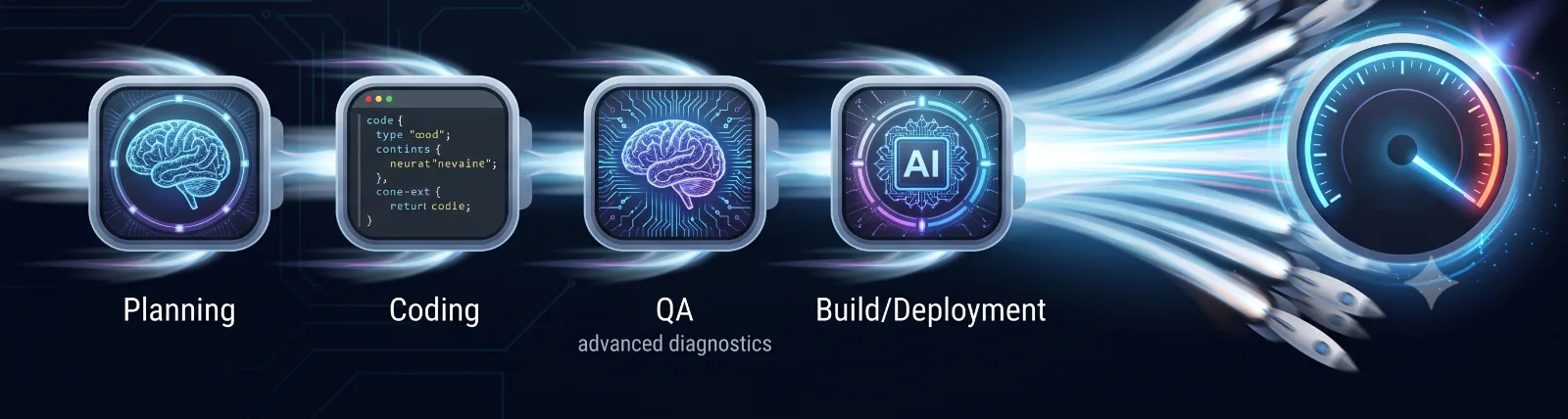
Governance that doesn't measure manages by intuition
In development teams, a tech lead's intuition has a clear limit: it can't simultaneously see the real state of twenty repositories, each developer's cycle time, the failure rate by change type, and the dependencies that will delay the next release. Data can. DORA metrics provide an objective assessment of team performance: measuring indicators like change lead time or failure rate lets leaders identify bottlenecks, allocate resources efficiently, set clear goals, and justify technology investments to other stakeholders.
AI turns that measurement process — once manual, retrospective and costly to maintain — into something continuous, automated and predictive.
1. DORA metrics: the standard that evolved
Since the book Accelerate was published in 2018, it's been nearly impossible to talk about measuring software-delivery performance without referencing DORA metrics. The framework has evolved to include five metrics since 2024:
Deployment Frequency: how often the team deploys to production. An indicator of pipeline maturity and continuous-delivery capability.
Lead Time for Changes: time from first commit to production deployment. Measures the delivery cycle's real agility.
Change Failure Rate: what percentage of deployments cause incidents or require rollback. An indicator of delivery-process quality.
Time to Restore Service: how long the team takes to recover from an incident. Measures operational resilience.
Reliability (fifth metric, 2024): real system availability against declared targets.
Elite teams in 2026 deploy multiple times a day, with lead time under an hour, change failure rate under 5%, and recovery time under an hour. Various tools make measuring these metrics easier, automating data collection and providing detailed reports on team performance.
2. Lead time and cycle time: the difference that matters
The terms get used interchangeably and don't mean the same thing — and the confusion leads to wrong decisions.
Lead time: time from ticket creation in the backlog until it reaches production — includes wait time before the team starts working. Cycle time: time from when the team actively starts working on the ticket until it reaches production. Lead time for changes (DORA): specifically the time from first commit to deployment.
The most uncomfortable 2026 data point: the 90th-percentile end-to-end cycle time climbed to 66 hours among teams with high AI adoption in 2025, and in 2026 it has only partially come down. The reason: AI accelerates code writing but the bottleneck moves to PR review — the team produces code faster than it can rigorously review it. AI doesn't improve lead time if review doesn't scale with production.
Modern tools capture these metrics from Git and CI/CD data, with no manual reporting effort, and correlate them with team behavior to identify which patterns really shorten or lengthen the cycle.
3. Delivery forecasting: from committed date to data-backed probability
Traditional delivery estimation — planning poker, average historical velocity, PM judgment — produces dates that 65-70% of software projects miss. Not because teams are bad at estimating, but because the average estimate hides the real variability.
AI-powered predictive scheduling analyzes the team's historical performance, bottlenecks and lead times to recalculate delay probabilities before they happen. The result isn't "we finish October 15" but "there's a 75% probability of finishing before October 15, with a pessimistic scenario of October 30" — an answer that honors real uncertainty instead of hiding it.
AI agents for PMO act as tireless, precise, 24/7 digital analysts: a document ingester (minutes, timelines, emails, Jira exports), a KPI analyzer (progress, effort, load, deviations), a risk engine (automatic detections + PMO heuristics), and a report generator (weekly natural-language reports). An automatic project-status report looks like this: "Overall status: Moderate Risk. Progress 56% (target 60%). Critical tasks delayed: 12%. Unconfirmed external dependency — estimated impact +9 days. Backend team overload +22% unplanned effort. Recommendations: meeting with external vendor before Wednesday, adjust Sprint 14 scope by cutting 2 stories."
4. AI-powered PMO: from a reporting function to a strategic intelligence unit
By 2026, the PMO role transforms from a reporting function into a strategic intelligence unit. AI in project management handles the science of estimation and tracking, freeing humans to master the art of leadership and strategy.
The Intelligent PMO is an organizational intelligence hub that turns project management into an analytical, predictive, adaptive, data-driven system, with tools that answer not just "what's happening?" but also "what's going to happen in the project?" and "what decisions need to be made?"
The technologies supporting it: generative AI for risk prediction, timeline estimation and decision optimization; automatic report generation and information analysis; RPA + AI for executing repetitive tasks like tracking and control; digital twins to simulate scenarios before executing them; and AI agents capable of analyzing, deciding and executing routine or complex tasks that people used to perform.
Leading PMOs in 2026 move beyond reporting to serve as enterprise-enablement engines: connecting strategy with execution, building in readiness from the start of delivery, and ensuring governance keeps pace with AI and agent rollouts.
The prerequisite nobody mentions: you can't layer advanced AI on top of a fragmented data landscape. If resource data is in Excel, financial data is in an ERP, and task data is in a siloed ticketing system, an AI agent is blind. Centralizing portfolio data is the precondition, not a parallel project.
5. Automated technical audits: continuous governance, not point-in-time
Traditional technical auditing is a project: every six or twelve months, an external team reviews the code, architecture and processes and delivers a report. AI turns it into a continuous process.
Internal AI auditing must verify that automated decisions are explainable, that audit logs are immutable and traceable, and that human-review mechanisms exist for critical decisions. In practice, automated technical auditing covers:
Continuous code quality. Static-analysis tools measure technical debt, cyclomatic complexity, duplication and coverage on every commit — the team sees the trend in real time, not in an annual report.
Standards compliance. Secure-coding policies, dependency licenses, infrastructure configuration (IaC scanning) — automatically validated on every PR without manual review.
Change traceability. Immutable audit logs for status reports and decision records ensure regulatory compliance and maintain investor trust. In high-risk industries, having logs that verify they haven't been retroactively altered to hide mistakes will become a standard requirement.
AI model auditing. AI governance requires defining who owns the use case, who is responsible for the model, what role the risk function plays, and how legal participates in assessing privacy and specific regulatory impacts. This is already mandatory in regulated sectors adopting AI for decisions affecting people.
The data point that justifies the investment in governance
Projects incorporating AI components are 40% more likely to suffer scope creep than traditional software, according to the PMI. Governance isn't bureaucracy — it's the structure that turns delivery speed into predictably delivered value.
The PM or tech lead who can say "based on last quarter's data, the probability of delivering this sprint on time is 82%, and the main risk is dependency on the X API review" has a different conversation with the client or executive than one who reports "we're doing fine, we think we'll make it."
Sources: Swarmia DORA Metrics Guide 2026, keepcoding.io DORA 2026, Larridin Developer Productivity Benchmarks 2026, arxiv DORA cycle time AI 2026, pmpeople.ai PMO AI agents 2026, gestion.pe Intelligent PMO ESAN 2026, Clarkston Consulting PMO Trends 2026, IEBSCHOOL AI Project Manager 2026, ISOTools Internal AI Audit 2026 — reviewed July 2026.
 Qi-Vanta
Automation and artificial intelligence for businesses. From discovery to production, with measurable ROI.