Context
Componentes Industriales del Bajío is a Tier 1 auto-parts supplier (stamped and injected parts) for automakers established in Mexico. With three production lines running 24/7, quality inspection depended on human staff at line's end, checking parts by eye or manual gauges.
The challenge
- Defect-detection rate (burrs, surface cracks, part misalignment) inconsistent across shifts — dependent on inspector fatigue.
- Quality claims (PPM) from automaker clients above the contractual target.
- Line speed limited by manual inspection time (bottleneck).
- Automotive client requirement: full per-part traceability (IATF 16949) and auditable inspection evidence.
The solution: edge computer vision
Instead of relying on manual inspection or sending images to external servers, the plant implemented a computer-vision system with proprietary models running at the edge, inside the production line itself.
ARCHITECTURE
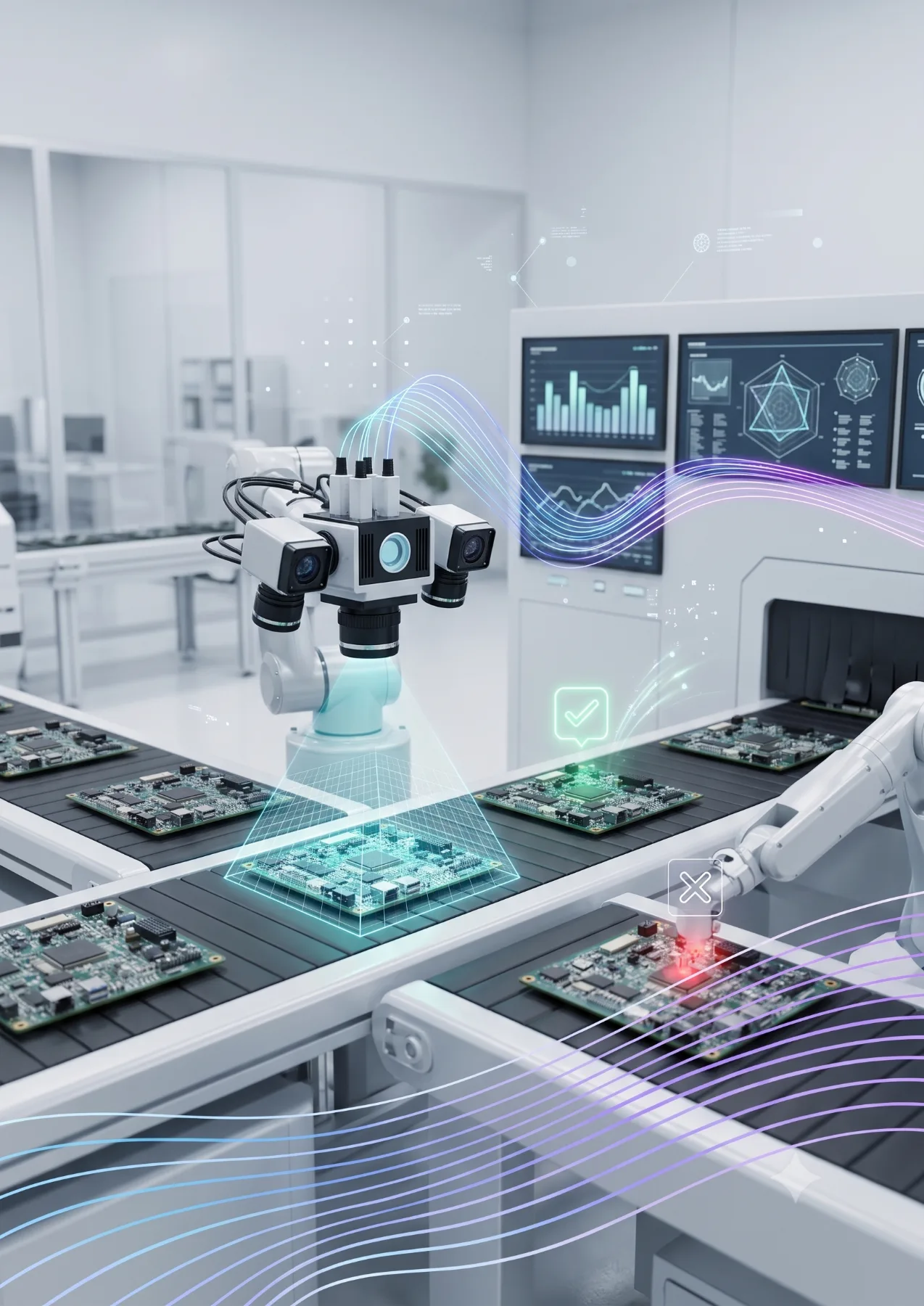
- Capture: high-resolution industrial cameras with structured lighting at 3 critical line points.
- Edge inference: the defect-detection model (convolutional network trained on historical OK/NOK part images) runs on edge devices next to the line, with no cloud-connectivity dependency — processing happens directly on the device, reducing latency, improving data privacy, and enabling faster reactions.
- Real-time decision: a part classified NOK is automatically rejected via actuator before moving to packaging — no human intervention needed in the normal flow.
- Traceability: every inspection is recorded with image, timestamp, and result, linked to the batch number — evidence ready for IATF audits.
- Continuous retraining: edge cases (low model confidence) route to a human inspector; those decisions feed the model's monthly retraining.
- Proprietary model, no third-party dependence: by not sending product images or design specs to external services, the plant protects the automotive client's intellectual property.
Results at 6 months
| Metric | Before | After |
|---|---|---|
| Inspection speed | ~4 sec/part (manual) | <0.8 sec/part |
| Defects detected before packaging | ~82% | 99.2% |
| Client quality claims (PPM) | Base 100% | -71% |
| Parts reworked due to false rejects | Base 100% | -45% |
| Manual inspection hours per shift | 8 | 2 (low confidence only) |
Inspection staff transitioned to an exception-validation and continuous-model-improvement role, instead of repetitive piece-by-piece inspection.
Key success factors
- Proprietary model running at the edge, not a closed "smart camera" from a vendor — allows tuning the model to each client's specific parts.
- Well-designed lighting and capture from the start — most machine-vision failures on the floor come from poor capture, not the model.
- Human in the loop for low-confidence cases, preventing the system from making blind decisions on ambiguous parts.
- Traceability as a byproduct, not a separate project — every inspection generated auditable evidence with no extra effort.
Lesson to replicate
The differentiator wasn't just "putting a camera with AI" — it was designing the system to decide on the line, without depending on the cloud, with proprietary data capture and a clear retraining process — especially relevant in manufacturing, where latency and protecting client designs are critical.
 Qi-Vanta
Automation and artificial intelligence for businesses. From discovery to production, with measurable ROI.